26 April 2009

Stuck in the world's highest city: a dynamite & diahrrea conspiracy

Potosi was once a city of unbelievable wealth, the richest city in the world, a wealth that was generated by the plundering of the abundant silver present within the big, brown mountain 'Cerro Rico' whose moody presence looms over the city.

The Spaniards, using the slave force of millions of indigenous people and imported African slaves, managed to extract so much silver that it was said to have underwritten the spanish empire for 2 centuries. Up to 8 million people died under the hellish conditions of the mines, where miners are exposed to a variety of noxious chemicals and temperatures can range from between below freezing to 45 degrees celcious. The Spanish took almost all of it, and left Bolivia with nothing, as one of the poorest countries in Latin America.

Sadly, people still search for the few remaining slivers of silver. Thousands of people still work the mines, despite the life-shortening silicosis pneumonia which usually kills after 10 years of labour, and shockingly, up to 6000 children work there. They know that the majority of their quarry is long gone, and they barely make enough money to survive, yet they cling to the dream of one more big find.

We had the opportunity to visit the mine, and I almost went, but in the end the idea of scrambling around in a damp, crack 4km deep amongst exploding dynamite didn't quite draw me enough, and anyhow, we got to see a fascinating film called 'The devil's miners' that more than substituted. It followed the life of this poor 13 yr old who is working the mines with his 9 yr old brother as their dad died, so the need for family income left them with little choice in the matter.
Interestingly, the miners split their worship between their Catholic God, when they are above ground level, and El Tio, the devil, when they enter his domain. Each of the mines has its own devil, and the miners regularily visit him to adorn him with gifts to ask for safety and good fortune. They spend up to 24 hours at a time in the mines, hamster-like cheeks stuffed with coca leaves (which give energy and supress hunger) and may breath in a noxious mixture of gases whilst using basic pick-axes and gas headlamps.
We loved the city. Cerro Rico is so impressive, making an amazing unreal super-imposed backdrop, especially when it's colours morph from shade to shade as the sun make's it's daily descent. The worn splendour of the old streets and buildings tell of better times. One thing that took me a while to notice was the complete lack of chain supermarkets - probably the first city i've been to without them. As we don't use these over-packaging, producer-exploiting, 'corporate take-over of our foodchain' - attempting stores of discontent, we wouldn't usually notice their absence straight away. But as far as we could tell, Potosi was supermarket-free and small independent food stores are thriving. How refreshing. We met up with Chaz again, and decided to go and watch a local derby between Real Potosi and another team from the city. The game was pretty mediocre, and the atmosphere lackadaisical, but it's highlight was pretty amusing. The presence of the military police was explained after the linesman on our side made a dodgy decision, which the crowd didn't take to well. A deluge of fruit and empty plastic bottle flew towards him, and landed around his feet as the game continued. He tried his best to pretend he hadn't noticed, but as the bombardment continued, two military police moved between him and us and held their riot shields up to stop the rogue apple cores from interuppting his game!!!!

We found a great little restaurant called the Llama, which did a nice selection of veggie set meals, and a few llama dishes. Llamas are an animal of huge importance in the Andes, as a source of food and wool. After a bit of research about their rearing, we found they were free-range, and decided to treat ourselves with a rare meat meal. It was lovely, I devoured the pork-like meat like a wolf. The restaurant also doubles up as a book exchange, and I found a selection of speaches by Hugo Chavez, which is pretty interesting.

We had planned to leave, but decided to stay one more day to check out a museum. Little did we know that a 48 hour strike and blockade of the city had been planned. So, we awoke to find that no transport would be entering or leaving the city for the next two days, and that many businesses - including the museum which had been our reason for staying the extra day - were closed in solidarity. The miners had blockaded the main roads, whilst locals closed the inner city roads with plastic tape, banners, and loads of big rocks. And so it was, our first Bolivian blockade! It was actually quite nice - the blockades here are a regular occurance, and often have the vibe of a public holiday. People set up their stalls and children and adults alike played games in the middle of the car-free streets. It all felt a bit like a 'reclaim the streets' protest. I think they were calling for better roads, as the current roads are no more than rough dirt tracks. But then the miners seemed to be behind it, so we weren't quite sure what it was about (I later learned that historically the miners have taken a lead role in many political actions in Bolivia).

On the second day we'd heard that some taxis were taking people out and on to Sucre, if you paid them a bit more, so we decided to join a French and Swiss girl who were going to look for a taxi. As we approached the bus station there was a fair bit of commotion and and there were a big group of miners who seemed to be getting tad rowdy, it looked and sounded like they were brawling, but I couldn't be sure. There were a few massive bangs as they let off sticks of dynamite. It all seemed a bit tense, and a lady selling bus tickets for one of the bus companies was trying to tell us that it was impossible to leave until 7 pm, when the 48 hours was up. We decided to look for a taxi all the same, agreeing that as a bus ticket vendor, she'd obviously be inclined to tell us that. But, as we turned a corner, we realised that it would probably be best we waited after all. One taxi had found an unblocked street, and driven away, much to the annoyance of the miners, who proceeded to run over to block prevent further cars from doing the same. As more dynamite exploded, another car attempted the same route, only to be met by miners who surrounded the car and began letting the tires down and forcing the doors open!!! Other cars that had been heading for the same route began reversing speedily back up the hill, and we decided to follow suite! It was pretty exciting stuff! The people here certainly let thier voices be heard when they want something done. I can't imagine the people of a city in the UK coming together to blockade the city for 48 hours to make demands on the government (though sometimes I wish they bloody well would)!

So, we decided we'd let it run its course, and stay one more night. We bought tickets for early the next morning and checked into a hotel accross the road from the bus station. It was a grade A shit hole, but at least we wouldnt have to worry about getting to the bus station early the next day. Unfortunately, later that night, Colette woke up with a dodgy tummy, and was soon bursting from both ends. This went on throughout the night, and sure enough my stomach began too, and we were soon tag-teaming the loo. There was no way we'd be getting that early morning bus, so I asked if we could pay for half a day, to give us chance to recover before the evening bus. We took the day to recover, and felt well enough to travel on to Sucre in the evening.

Salar de Uyuni - the world's biggest salt lake

We set off in the morning and met up with the two others we'd be sharing the Jeep with for the 4 day tour, Arry from london and Lesley from the States.

We began our ascent and our first stop was a view over a deep gorge with a dry river bed at the centre, below tall, impressive red craggs. We continued up and up along a winding dirt track, sometimes with steep drops on either side.


After around 7 hours we stopped in a tiny settlement, San Antonio de Lipez at 4200m above sea level, with stunning views of a nearby snow-capped montain and a little church and stream. It was such a peaceful place. Choalitas rounded up a herd of Llamas and lead them across the stream as I sat and watched. Each llama had brightly coloured fabrics woven into their fleece's and around their ears, the traditonal practice of an indigenous festival, giving them the appearance of 'cyber-llamas' returning from some kind of llama rave. As soon as the sun disappeared behind the hills the temperature dropped off quicky, and we felt the harshness of this barren, desolate habitat. We found the bodyof a huge Condor - it was only a juvenile and was still massive, and had apparently died of natural causes.


Interestingly, each of the small mud houses has its own solar panel, supplied by the government, to provide what little electricity the people there use. Looks like even Bolivia is ahead of the UK in solar capacity. Later in the evening the stars shone brilliantly, and the milkyway spread across the sky like a sliver of pale mist. We had a lovely dinner prepared by our guide and his helper, and retired early to our beds to mummify ourselves in piles of thick blankets.


4am start. The air was so cold and thin and Mercury shone bright above the the horizon. After a hearty breakfast and a short drive we stopped at the ruins of an ancient town which had been abandoned. The sun hadn't yet materialised from behind the hills and we wondered around the eerily silent remains of a town which had been abandoned under mysterious circumstances. Apparently bad spirits had decided to move in and people had begun to die, one by one, so the people did a runner - spooky stuff.

We set off again and passed vicuñas (a bit like a deer), some animals that resembled chinchillas and loads of llamas. The sun rose and we enjoyed its warmth as landscape merged into desert.


We stopped at this amazing area of crazy rock formations formed by weathering, including the 'tree of rock'. Spent 30 min or so clambering around on the rocks - I love climbing around on stuff, i'm sure it's a hangover from our ape days. Might have to get involved in a bit of rock climbing when I get home.

There was so much breathtaking scenery we could hardly breath. Actually that was probably the altitude. We reached 4900 m above sea level at one point. The physical effects on your body include shortness of breath and a slight throbbing pressure like sensation on the old cerebrum, a little unpleasant times, but nothing too unbearable. We made like the locals and chewed mouth fulls of coca leaves which seemed to help.


Over the following three days we stopped at stunning glacial lakes with flocks of pink flamingos sifting through the turquoise water, snow capped volcanos and smooth, banded hills looking like scenes from Dali paintings. We stopped at a thermal pool for a dip in waters 30 C warm, checked out some geysers of bubbling mud and eggy sulphurus steam, and mirror-perfect lakes that reflected the surrounding mountains.


On the final morning we drove to the actual salt lakes before sunrise. Salar de Uyuni is the world's largets salt flats at 10,582 km² . About 40,000 years ago, the area was part of the massive prehistoric Lake Minchin. Eventually the lake evaporated, leaving behind Poopo Lake and Uru uru lake, and two major salt deserts including Uyuni. It's the most surreal thing I've ever experienced. It's incredibly vast, white, crispy salt, split into a consistent pattern of cells stretching as far as the eye can see. It felt like walking on hard snow. The sun began to rise. It was a gorgeous moment, ruined temporarily by the our driver blasting some ridiculous 80's classic from the Jeep (can't remember the track, it was a classic, but there's a time and a place - maybe a school disco or wedding, but surely not here). I don't know what he was thinking.
We then headed to the 'island' Lomo Pescado which is just bizzare - an island made of ancient coral reef covered in cacti up to 15 ft tall. I climbed to the top and got an idea of just how huge the flats are. It seemed like a real island in the middle of a calm, white ocean. I'll never forget it.
Met a nice chap called Chaz from Gloucestershire. We chatted about his home on a longboat, and once again it got me thinking about whether or not this could be an option for me one day. Certainly one way of keeping ahead when rising sea levels begin to reclaim the land.

After breakfast at the island, we continued on through the bright sea of salt, stopped to take a few photos, and watched the weekly 'crossing of the train' - the one train which crosses the flats to transport salt and minerals to Chile (whose distant mountains we could see).

It was a great 4 days, even though it was a long time to spend in a Jeep. It was amazing to see so many different landscapes over such a short period of time, and to get a glimpse of Bolivia's natural untainted beauty (well, i suppose it was slightly tainted by the presence of the many tour Jeeps bombing around, including our own). Definately one of the highlights of the trip. We arrived in the town of Uyuni, bought our bus tickets to Potosi for later that evening, ate some mexican food with Chaz, and got ready to move on once again.

16 April 2009

Tupiza

The bus ride from Villazon was awsome. As we made our bumpy ascent into the mountains we passed some fantastic scenery . As the light diminished the black outlines of cacti on the hills resembled an exodus of strange alien figures . We saw our first Llama. After emerging from a mountain tunnel, we spotted the carcass of a coach that had tumbled to it's fate 200 feet below - a reminder of the dangers of Bolivian roads.


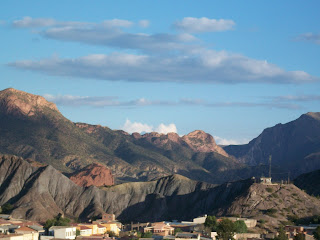
We arrived in Tupiza and found a little place for 40 bolivianos a night - roughly 4 quid between us. The balcony looked out onto the jagged red clay mountains that lay on one side, the kitchen over looked the grey rocky hills on the other. Depending on the time of day, the various types of hills and mountains surrounding us would change colour. There were various shades of greys, browns, and reds, and despite being barren and desolate, it was beautiful. From time to time we spotted herds of wild mountain goat clambering amongst the red rocks far and high in the distance.

Tupiza is just under 3000 metres high, and we could feel it- the smallest of actions could leave us feeling breathless.

We met a few other travelers and went to the nearest 'bar'. We were led by a man through the front of his little llama/alpacca clothing shop out into the back, to his new pride and joy - a bar which he hoped would soon be the centre of Tupizza'a nightlife, but which was empty for the moment.

The next day, we went for a bit of a hike, with a French girl called Rafael. The scenery was stunning, and throughout the day I enjoyed moments of the rare sensation of silence. We walked along dried-up riverbeds, between dry shrubs and cacti, climbed a huge rock formation called 'punto del diablo' (the devil's point) and big clay/scree hills that resembled huge solidified globs of volcanic lava. We found huge canyons, and passed high, jagged clay formations that towered above us looking sinister like a landscape lifted straight out of The Lord of the rings. It was somewhere in this region of Bolivia where Butch Cassidy and the Sundance kid met their maker at the hands of the Bolivian police in 1906. It made a nice change to be able to go for a walk without having to take a guide and pay through the nose.
We met a couple of lovely Irish gals on horses, and later on that night we all met up for dinner.

The next day, we got up and prepared for a 4 day Jeep tour around Bolivia's South West, finishing in the famous 'Salar de Uyuni', the world's largest salt lake.

14 April 2009

Bolivia bound

By the time we'd reached the bus station, we'd decided to give the north of Argentina the wide birth, due to tales of dengue death and mayhem. We'd hoped to camp, but came to the conclusion that this was a bad idea. It was mainly Colette who had the doubt - I had been of the opinion that we should find out exactly where the outbreaks were and avoid those areas, not the whole region. However, 2 things made me realise we'd probably made the right choice; as we boarded the bus for Jujuy anyone boarding north bound buses was handed a free big bottle of 'Psst' mosquito repellent, courtesy of the Argentinian government, and during our 30 hour bus ride, I saw south bound traffic being stopped and fumagated by men in boiler suits and masks at least 3 times. Some people complained about over the top media scare mongering and claimed that it was nowhere near as bad as people were saying. We decided against finding out for ourselves. We really were due to be in Bolivia by this point anyway.

We arrived at La Quiaca after dark, and decided to stay the night and cross the border the next morning. Stepping off the bus we could imediately feel Bolivia's proximity. The indigenous blood was evident in the faces of the people and the traditional dress of the women, or 'cholas' who sat huddled in groups amongst their blankets and wears, chewing mouth fulls of coca leaves. As it was Easter saturday we could hear Mass being projected into the night by loud speaker from the church. The mountain air felt clean and crisp after so long in the city, and the beds in the chilly little hotel were necessarily equipped with layers of thick alpaca blankets.


After a good night's sleep we had breakfast and set off for the boarder, which was a 10 minute walk along a disused railway track. It felt like we were walking through the set of an old wildwest movie, rugged and dusty with mountains in the distance.

The boarder crossing was pleasant as far as boarder crossings go. There was no que, the official was cheery and it was all very straighforward and swift. The cheeky face of Evo Morales beamed down at us from a poster hung on the wall (Bolivia's first indigenous president). We walked over a bridge and saw people washing clothes in the river below. Walking up the street we passed Cholas selling fruit, street stalls selling anything from cigarettes to pliers and, behold, juice ladies! We'd being missing fresh fruit juice in Argentina, and hadn't really seen any since Colombia, so we were happy to see the juice ladies with their orange press mobile stalls out in force. Pomello for me, 25p. The street was colourful and buzzed with activity and we traded the last of our Argentinian pesos for bundles of ancient looking Bolivianos. We were in Bolivia.

10 April 2009

A few Buenos Aires shots (more to follow)


Buenos Aires Pt III: other stuff


One weekend we visited a guy who lives in the Delta of Tigre, north of the capital. He had bought some land and was hoping to create a sustainable eco-village where couch surfers could come and stay in exchange for a little work. He'd invited anyone on the couch surfers website to come along for a working weekend. It was a beautiful area with rivers lined with weeping willows and a few oaks here and there giving it quite an English feel. We talked of his plans, shared ideas, did a bit of land clearing with machettes and then had a sleep over in a wooden shack on stilts with candles and a bit of a sing song. Was very nice, and met some great people. Unfortunately we left before the Kiwi guy arrived to build an earth oven - really want to pick up some natural construction skills and this would have been a fine chance.


In one unfortunate week I left my card in the cash machine and had my account emptied and had my MP3 player stolen at a hostel. Wasn't too bad in the end though - the bank refunded my money and the guy who was responsible for leaving my MP3 player in a vulnerable place coughed up some cash, whicch was quite a result, but will never make up for the loss of my music.

One night we went out with our friends Yami and Santiago from Colombia to a 'contact dance' night at this big house where a traveller/hippie/new age type community live. There was some live music, some entertaining performance, and plenty of contact dancing - an intimate dance where people dance with each other whilst maintaining body and eye contact. Basically it looks like people rolling around on each other's backs and jigging aound each other in circles whilst always touching. At times it was mesmorising and quite cool to watch, which is all I did - not wearing the appropriate atire of hemp fisherman pants and poncho was my official excuse for not participating. It was a fun night, but once again I was disappointed by the aire of supiriority given out by so called 'hippies'. I've been to my fair share of hippie gatherings and I've often left feeling that the community seemed quite closed and cliquey, and looked down on those who didn't know whether their chakras were open or closed, or who didn't adopt the lotus position and meditate at any given chance. Surely to be open to all people and the desire to share philosophies with others should be the ways of the enlightened hippie? How are you going to change world conscienceness by sticking in closed groups and shunning outsiders or newcomers? Was fun overall though, and had a good old bash at various percussive instruments during the spontaneous jams that broke out through the night.


One day we went with Alcira to a permaculture day, out in the country. It was a nice day out, and made me realise how much I craved some clean country air. We didn't learn that much on the day, as it was all in Spanish, but we did learn about a technique of planting called-Fukaku named after it's Japanese inventor, who is a bit of a legend amongst the permaculture movement. Whilst there, we met a lovely couple called Dave and Elisa. Dave is English and had met Argentinian Elisa in the states back in the day, and they'd both moved to Argentina. They'd lived though Argentina's dark recent years - the 'dirty war' where up to 30, 000 people were 'disappeared' between '76-'83, under Jorge Rafeal Videla's military dictatorship. They currently live in La Plata just outside of BA and run an organisation called MACA (Musica, Arte, Cultura, Ambiente (environment)). As the name suggests, they're involved in the arts and environmental education and work with local youth and schools. I spoke about activism in the UK and they invited me to visit them and do an interview for their radio station.


On our last night we checked out 'La bomba' which is basically a weekly drum circle put on by this amazing percussion group in a little stadium type place just off some random street in the city. We'd heard a lot about it during our stay but had foolishly waited till our last night to go. It was fantastic - the drummers were amazing, it was far more than your average drum circle. These guys took you on a journey through loads of different styles, with intricate layers of complex patterns ranging from samba to an imitation of techno and other electronic genres. They have a 'composer' type guy who directs the group abd each week they have a guest musician play with them, from saxophonists to rappers to turntablists. In our case it was a funky jazz trumpeter. There must have been 500 people or more there, and together we lapped it up, dancing, cheering and drinking - it was true festival vibe! We had met up with our Irish friend Paddy (of Venezuela and Amazon river boat fame), Jeff and Yami, our former couch surfing hosts, and had a wicked last night in the city.


The next day, we'd decided to visit La Plata on our way out of BA, to honour our invitation from David and Elisa. And we're glad we did. David and Elisa are fascinating people and were amazing hosts. We stayed with them in their lovely home for 2 days and met their family, enjoyed Elisa's wonderful cooking, had interesting conversations and learned about what it was like to live through the 'dirty war', and learned more about the Falklands. We visited their friends who live a very sustainable life out in the countryside, and helped them distribute some Fukaku balls (they'd also been to the permaculture course). It was there I did the interview. Sod's law ensured that the one day on the whole trip I had an interview was the one day that a cold and sore throat robbed me of my voice. Literally, my voice had pretty much gone, and to make things worst, at the last minute I was told it would all be in Spanish! However, I soldiered on and with a bit of translation help managed to hold it together. They asked me about the trip, the ship, the voluntary work, activism and my opinions on environmental awareness in Latin America. So soon, my huskey broken spanish will be broadcast throughout the homes of Buenos Aires! Result!

We had the opportunity to camp on their friends' organic farm in La Plata to help out for a few days, but sadly had to decline due to time limits; the extra 4 weeks meant that we really had to push North and head to Bolivia.


It was such a shame that we had no time left to explore the rest of Argentina. There's some stunning areas such as Patagonia and the 'lake district', and loads of opportunity for camping (where we couild have put this blasted tent to use), not to mention the many organic farms we could have worked on through the WOOF network. But we simply had to move on. To stay any longer would have ment cutting time in Bolivia, Peru or Ecuador, all countries with volunteer work we were excited about.


We considered stopping off somewhere in the North of Argentina on our way up North, maybe Salta or Jujuy, but had been warned about an outbreak of dengue fever.

So, still undecided on exactly where we would go, we made our farewells to David and Elisa and took the train back to BA to find a bus to our next destination.